- Archaeology
A lavish tomb of a noblewoman discovered in ancient Greece includes a mysterious symbol of lost power.
8 Comments Join the conversationWhen you purchase through links on our site, we may earn an affiliate commission. Here’s how it works.
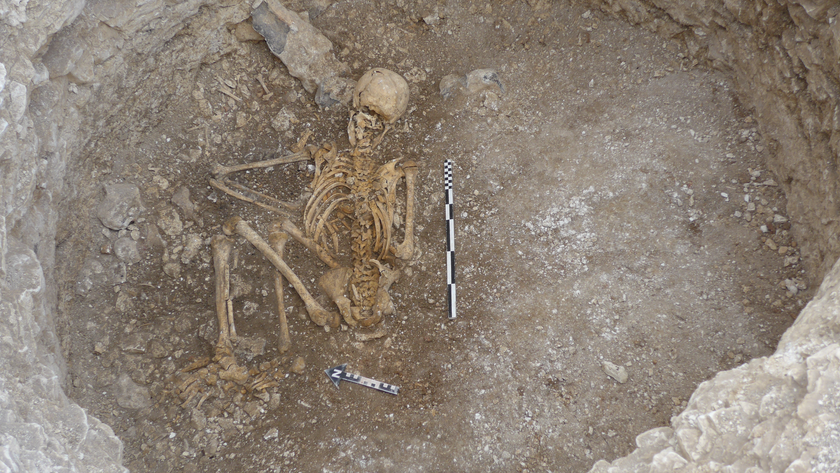
 The head of the "Lady with the Inverted Diadem" as she was uncovered during the excavation.
(Image credit: Greek Ministry of Culture)
The head of the "Lady with the Inverted Diadem" as she was uncovered during the excavation.
(Image credit: Greek Ministry of Culture)
Archaeologists in Greece have uncovered the grave of an ousted noblewoman whom they are calling "The Lady with the Inverted Diadem." The seventh-century-B.C. burial is notable for the elaborate bronze crown placed upside down on the woman's head, which may have signified a final end to her power.
The noblewoman's grave was unearthed at an ancient cemetery that was recently discovered in east-central Greece, about 60 miles (95 kilometers) northwest of Athens, during construction work, according to a Nov. 27 translated statement from the Greek Ministry of Culture. The 40 graves recovered thus far appear to be the burials of people of high social status who died in the Archaic and Classical periods (800 to 323 B.C.).
You may like-
 2,000-year-old gold ring holds clue about lavish cremation burial unearthed in France
-
 Viking Age woman found buried with scallop shells on her mouth, and archaeologists are mystified
-
 2,000-year-old Celtic teenager may have been sacrificed and considered 'disposable'
 (Image credit: Greek Ministry of Culture)
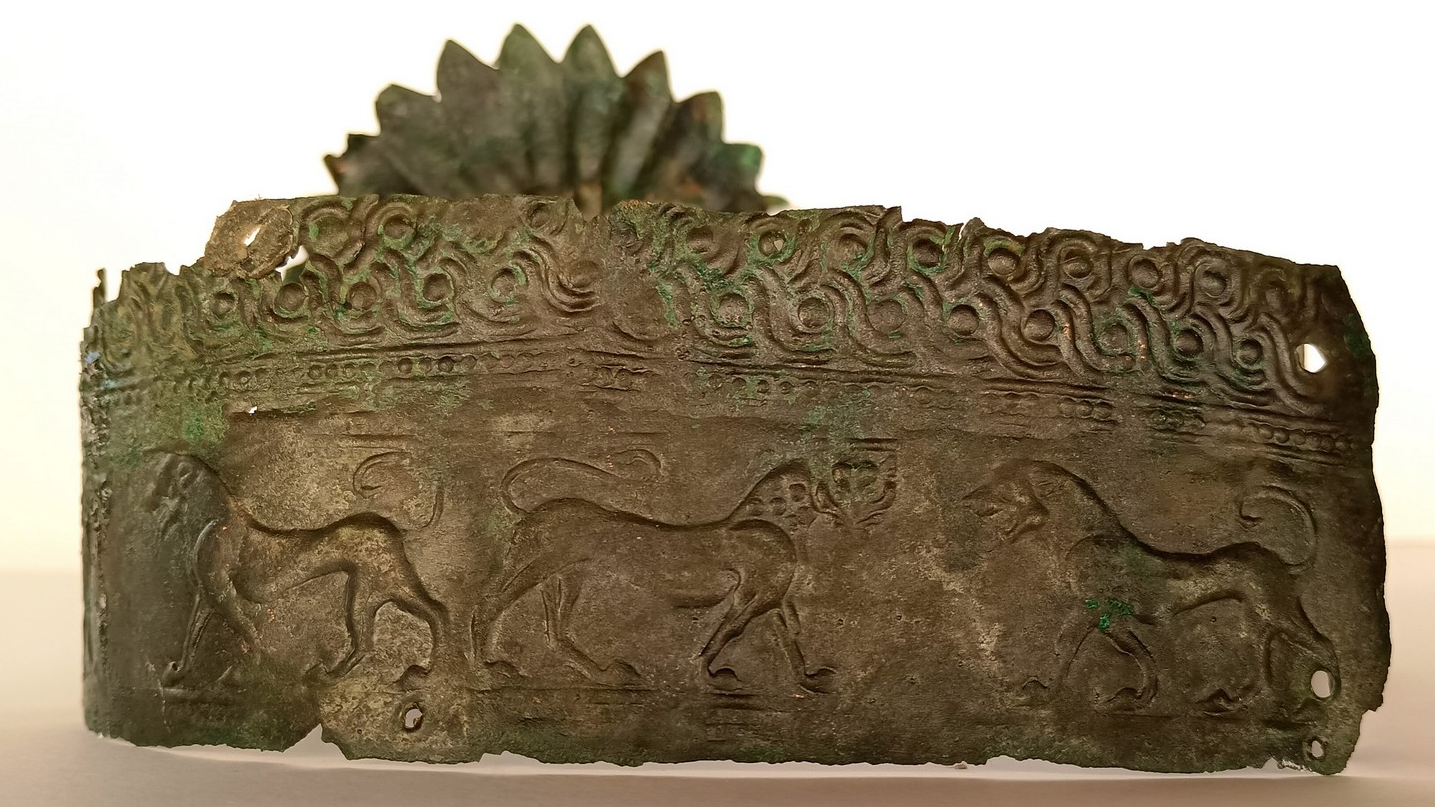
The back of the bronze diadem, with images of lions.
 (Image credit: Greek Ministry of Culture)
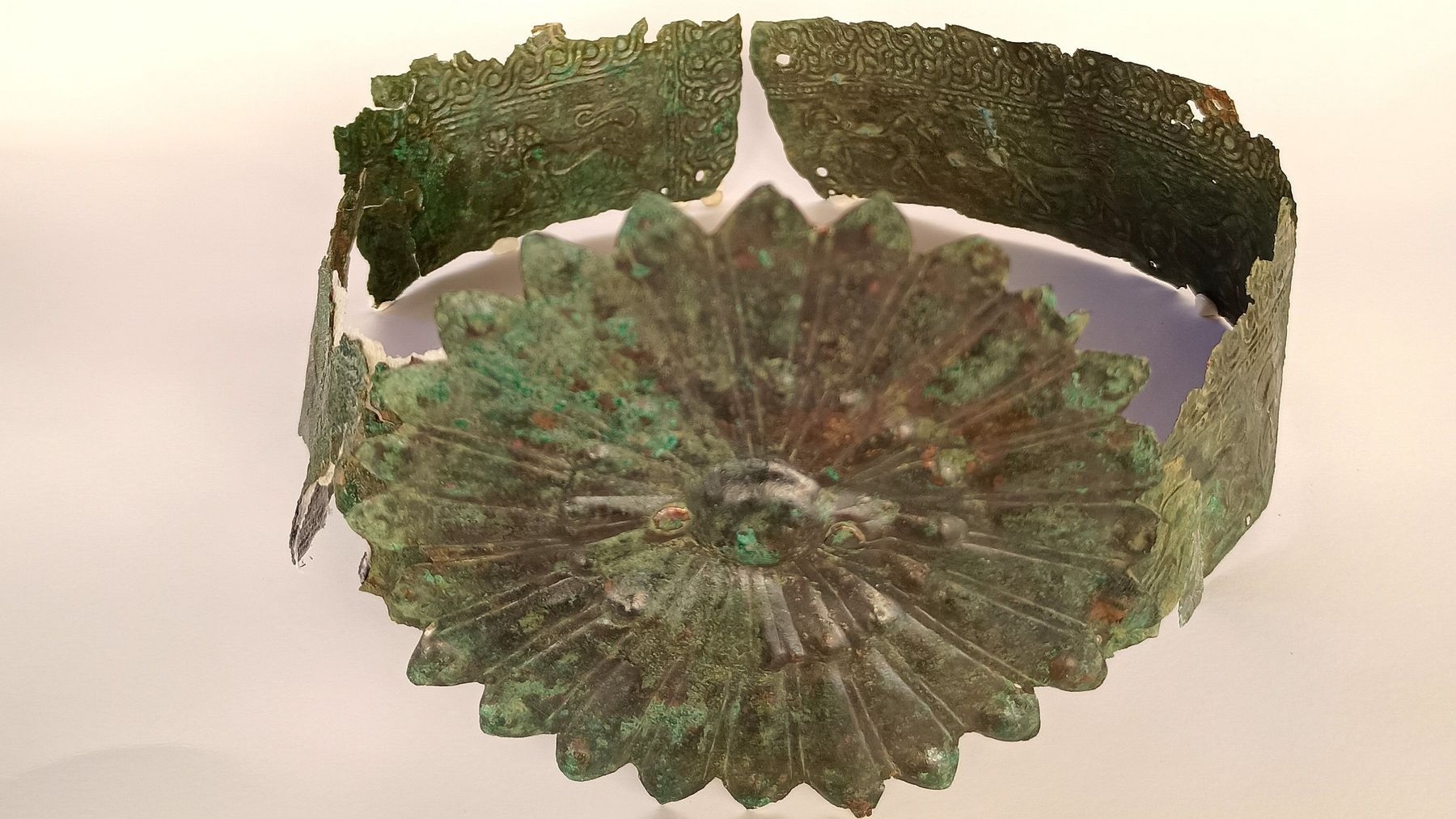
The front of the bronze diadem, with a large rosette.
 (Image credit: Greek Ministry of Culture)
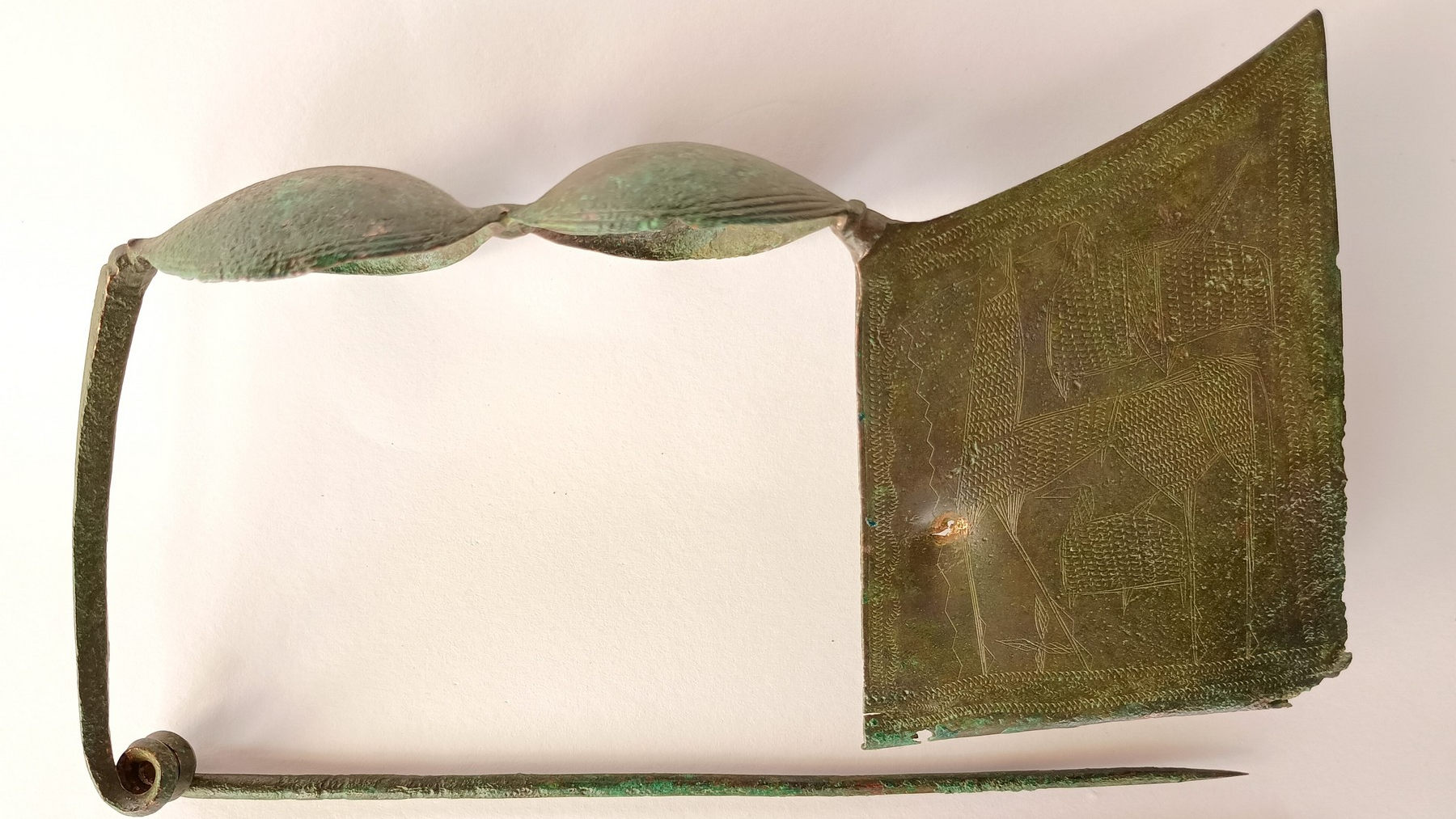
A large bronze pin with geometric-style horses found in the woman's grave.
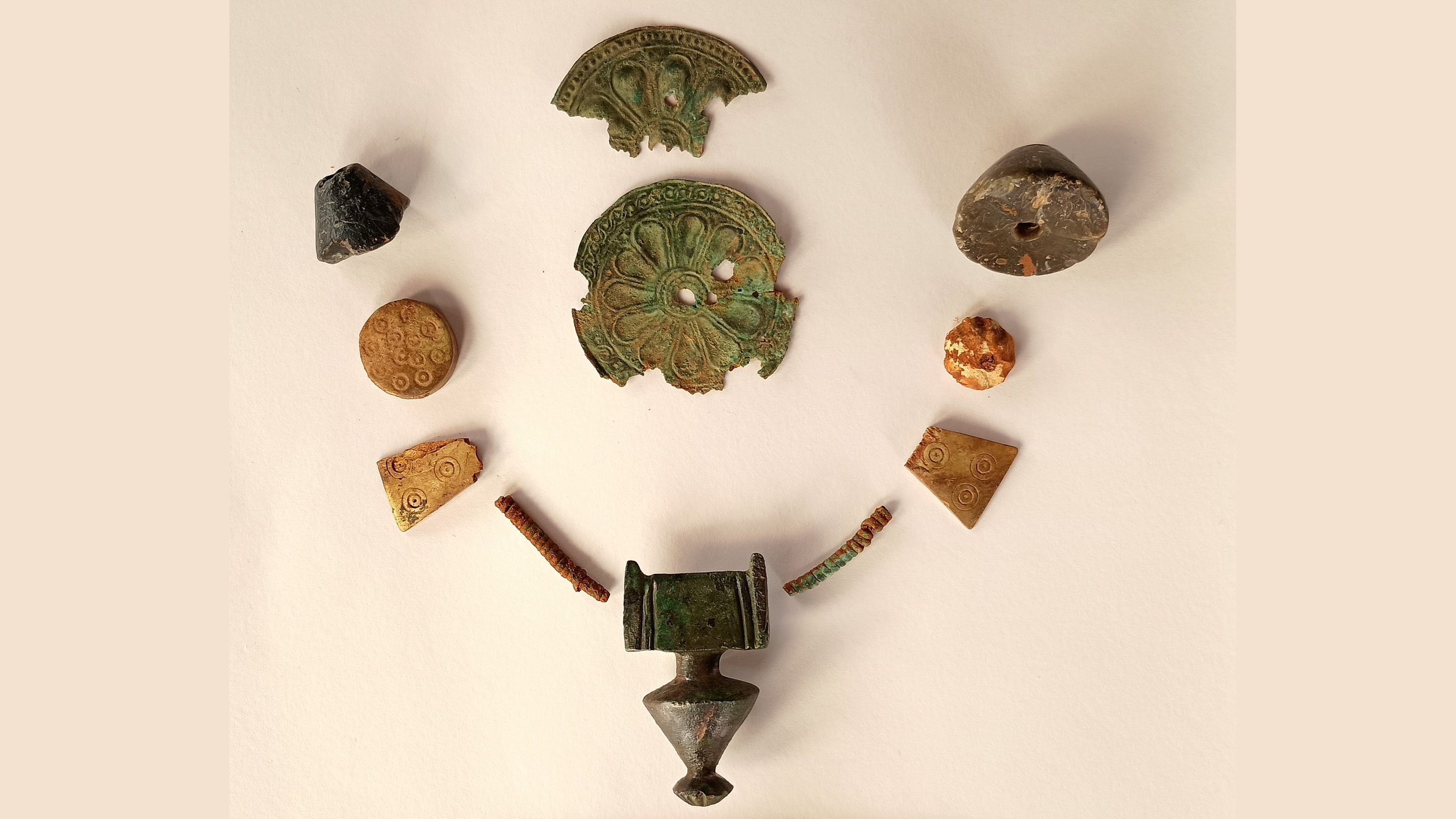 (Image credit: Greek Ministry of Culture)
A necklace with a vase-shaped amulet found in the woman's grave.
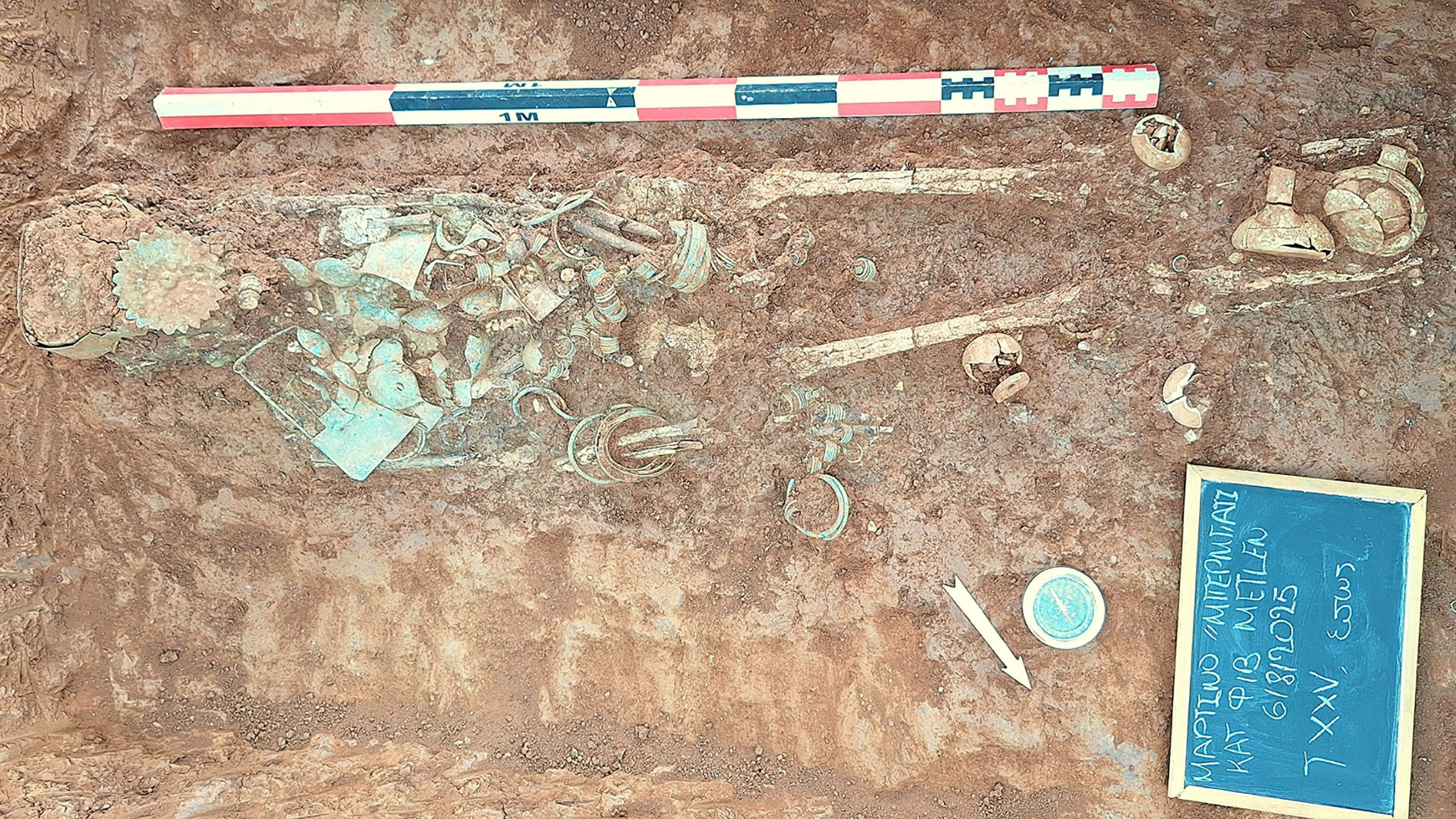 (Image credit: Greek Ministry of Culture)
An aerial photo of the woman's grave during excavation.
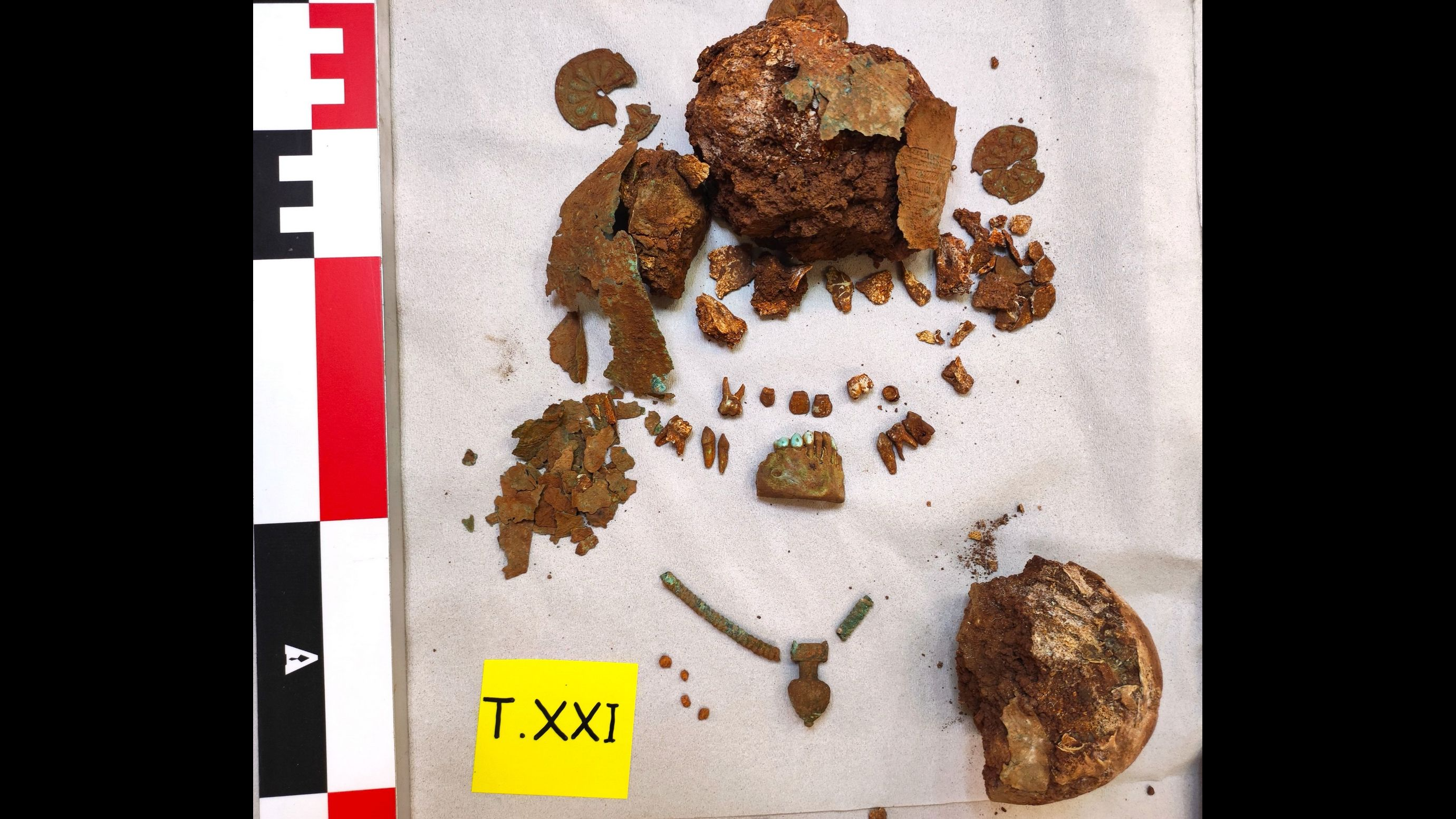 (Image credit: Greek Ministry of Culture)
A child with similar jewelry was buried near the woman.
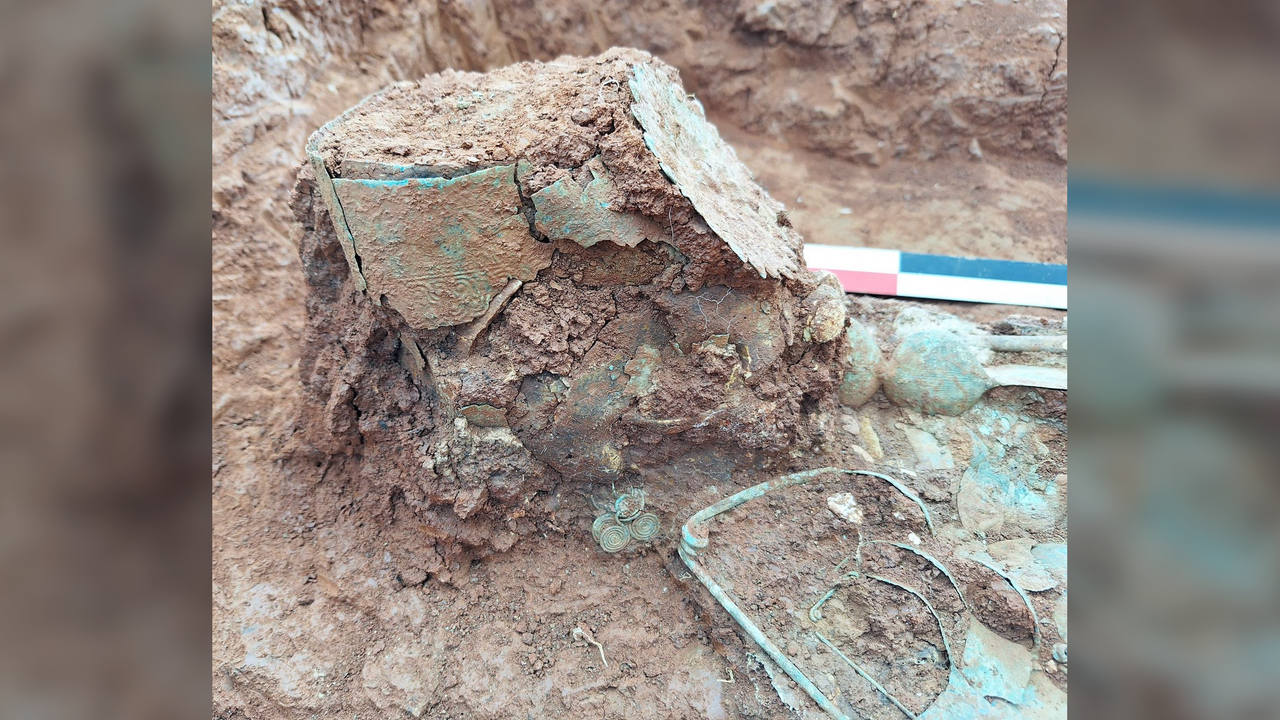
The woman's bronze diadem, in particular, caught the archaeologists' attention. It featured a large rosette on the front and a scene of facing pairs of male and female lions on the back. But the crown had been placed upside down on the woman's head so that the lions appeared to be lying down.
Lions symbolized royal power and authority, according to the statement, as can be seen in earlier iconography from the southern Greek city of Mycenae, where the so-called Lion Gate was a potent symbol of the king's power in the 13th century B.C.
RELATED STORIES—Apollo gold ring with 'healing serpent' found in 2,000-year-old tomb in Greece
—2,100-year-old burial of woman lying on bronze 'mermaid bed' unearthed in Greece
—2,800-year-old figurines unearthed at Greek temple may be offerings to Poseidon
An inverted crown, though, symbolizes the resignation or fall of a ruler. Therefore, this woman may have lost her privileged position during a time of social and political upheaval in the mid-seventh century B.C., according to the statement. That difficult time in Greek history was eventually resolved by the lawmaker Solon's reforms that laid the foundation for Athenian democracy in the early sixth century B.C..
Archaeologists also found the burial of a 4-year-old child near the woman. The child was crowned with a bronze diadem with small rosettes and dates to the same time period as the woman, suggesting they may have been related in some way.
Sign up for the Live Science daily newsletter nowContact me with news and offers from other Future brandsReceive email from us on behalf of our trusted partners or sponsorsBy submitting your information you agree to the Terms & Conditions and Privacy Policy and are aged 16 or over.Research at the site is ongoing and may reveal more graves in the near future.
Archaeology Fragments Quiz: Can you work out what these mysterious artifacts are?
 Kristina KillgroveSocial Links NavigationStaff writer
Kristina Killgrove is a staff writer at Live Science with a focus on archaeology and paleoanthropology news. Her articles have also appeared in venues such as Forbes, Smithsonian, and Mental Floss. Kristina holds a Ph.D. in biological anthropology and an M.A. in classical archaeology from the University of North Carolina, as well as a B.A. in Latin from the University of Virginia, and she was formerly a university professor and researcher. She has received awards from the Society for American Archaeology and the American Anthropological Association for her science writing.
You must confirm your public display name before commenting
Please logout and then login again, you will then be prompted to enter your display name.
Logout Read more 2,000-year-old gold ring holds clue about lavish cremation burial unearthed in France
 Viking Age woman found buried with scallop shells on her mouth, and archaeologists are mystified
 2,000-year-old Celtic teenager may have been sacrificed and considered 'disposable'
 'Extremely rare' and 'highly unusual' Roman-era tomb in Germany is completely empty
 2,400-year-old 'sacrificial complex' uncovered in Russia is the richest site of its kind ever discovered
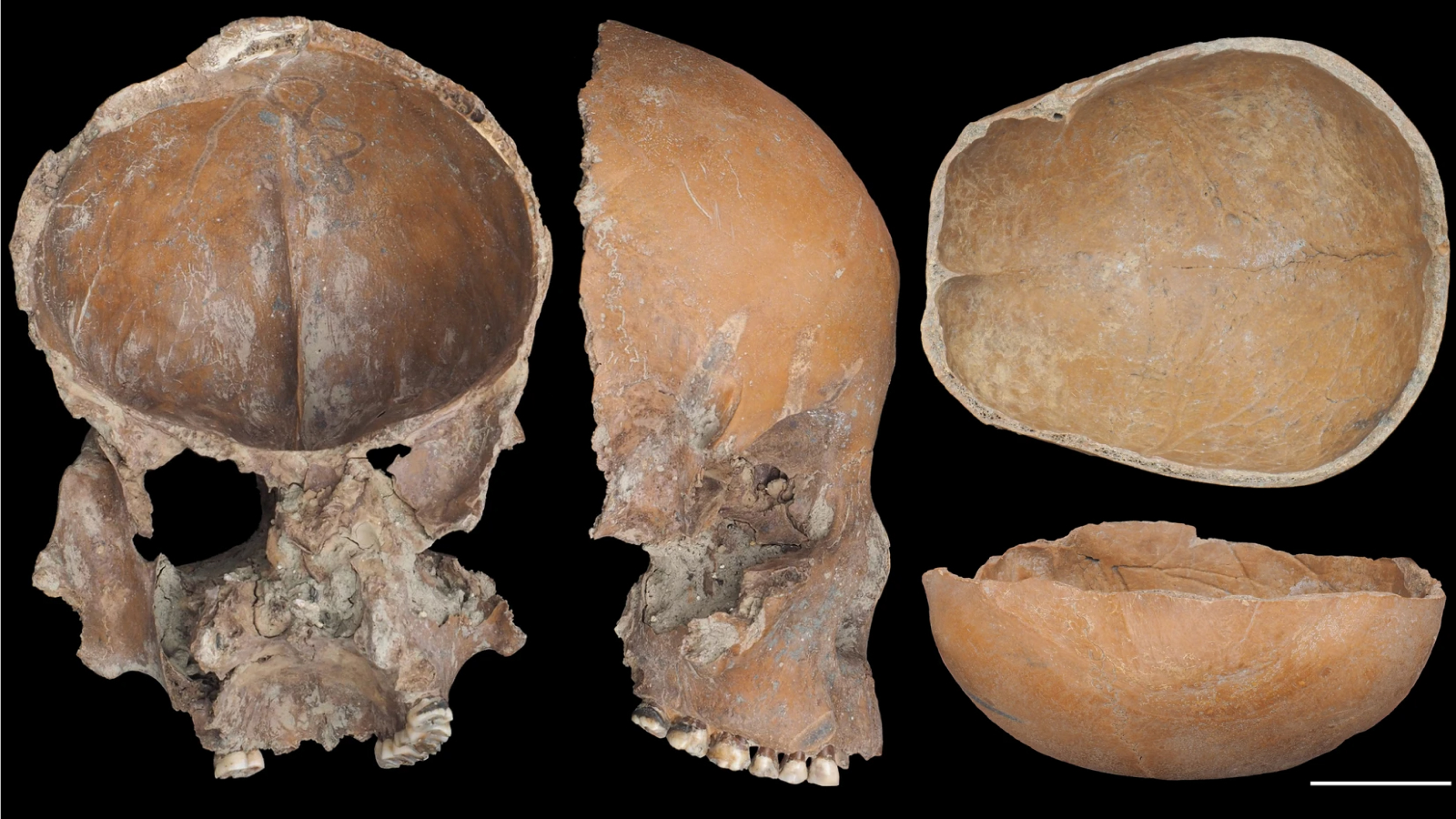 5,000-year-old skeleton masks and skull cups made from human bones discovered in China
Latest in Archaeology
5,000-year-old skeleton masks and skull cups made from human bones discovered in China
Latest in Archaeology
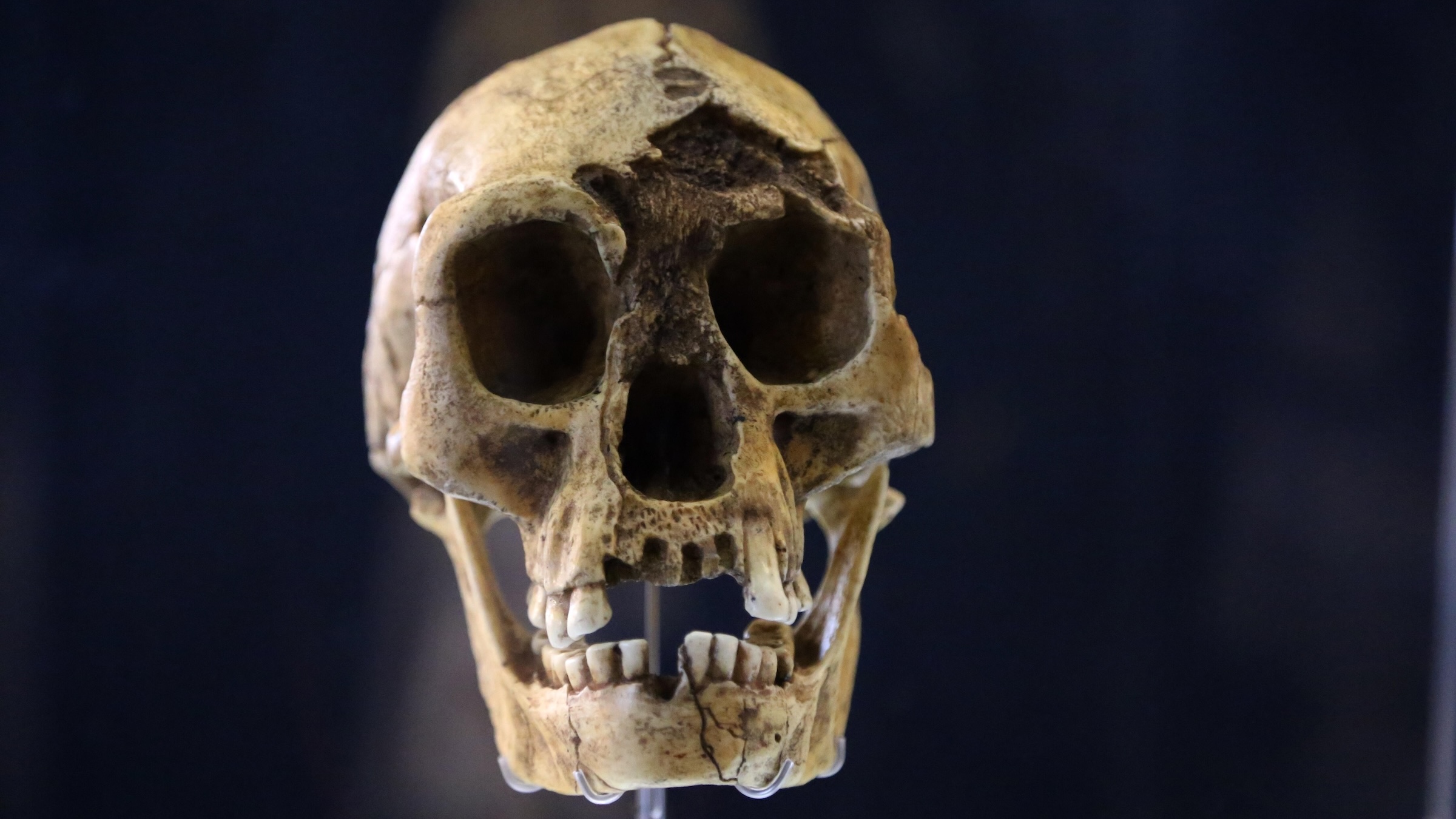 The 'hobbits' may have died out when drought forced them to compete with modern humans, new research suggests
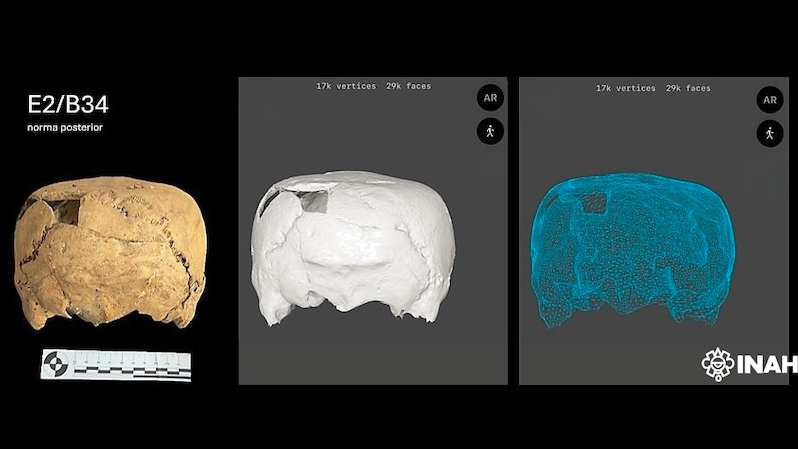 Unusual, 1,400-year-old cube-shaped human skull unearthed in Mexico
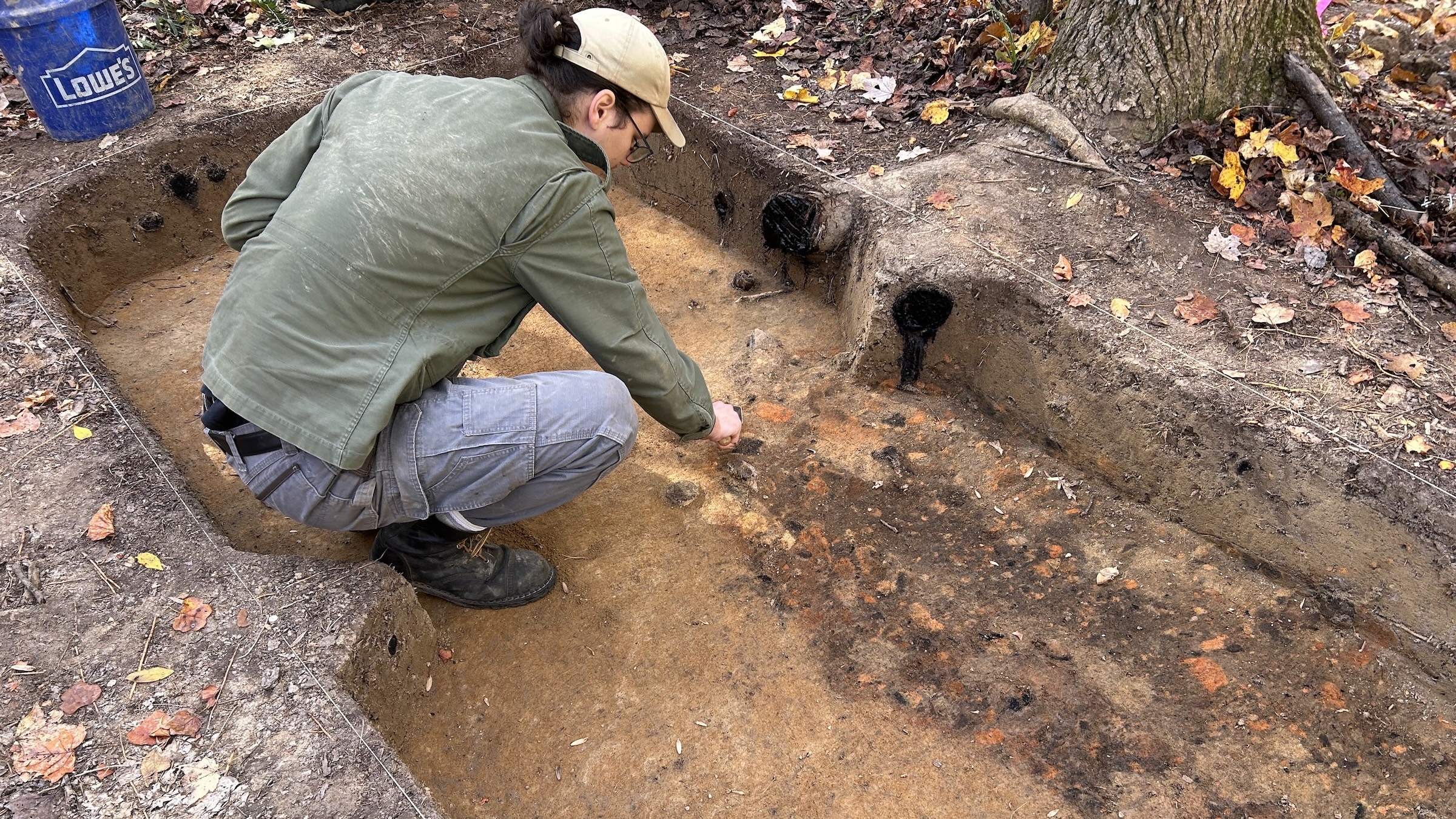 Lost Indigenous settlements described by Jamestown colonist John Smith finally found
 Ash Pendant: The only known depiction of a pregnant Viking woman
2,400-year-old 'sacrificial complex' uncovered in Russia is the richest site of its kind ever discovered
Ash Pendant: The only known depiction of a pregnant Viking woman
2,400-year-old 'sacrificial complex' uncovered in Russia is the richest site of its kind ever discovered
 1,800-year-old 'piggy banks' full of Roman-era coins unearthed in French village
Latest in News
1,800-year-old 'piggy banks' full of Roman-era coins unearthed in French village
Latest in News
 How to find the 'Christmas Star' — and what it really is
 Glue strong enough to tow a car made from used cooking oil
 Historic search for 'huge missing piece' of the universe turns up negative — but reveals new secrets of particle physics
 Today's biggest science news: Japan earthquake | Robot kicks CEO | Northern Lights forecast
 New 3I/ATLAS images show the comet getting active ahead of close encounter with Earth
 Ethereal structure in the sky rivals 'Pillars of Creation' — Space photo of the week
LATEST ARTICLES
Ethereal structure in the sky rivals 'Pillars of Creation' — Space photo of the week
LATEST ARTICLES- 1Is the 'Star of Bethlehem' really a planet? A bright visitor this month may hold a clue.
- 2Rare 'sunglint' transforms Alabama River into a giant 'golden dragon' — Earth from space
- 3Glue strong enough to tow a car made from used cooking oil
- 4Historic search for 'huge missing piece' of the universe turns up negative — but reveals new secrets of particle physics
- 5Today's biggest science news: Japan earthquake tsunami | Kilauea lava fountains | Northern Lights forecast