 Ligora/Getty Images
We may receive a commission on purchases made from links.
Drill bits come in a startlingly wide array of sizes, shapes, and job-specific types. Most DIYers and repairers will be familiar with the standard fare, usually featuring a multi-material head with a neat point at the top where each of the grooves meet. However, even this drilling solution is only "standard" for some.
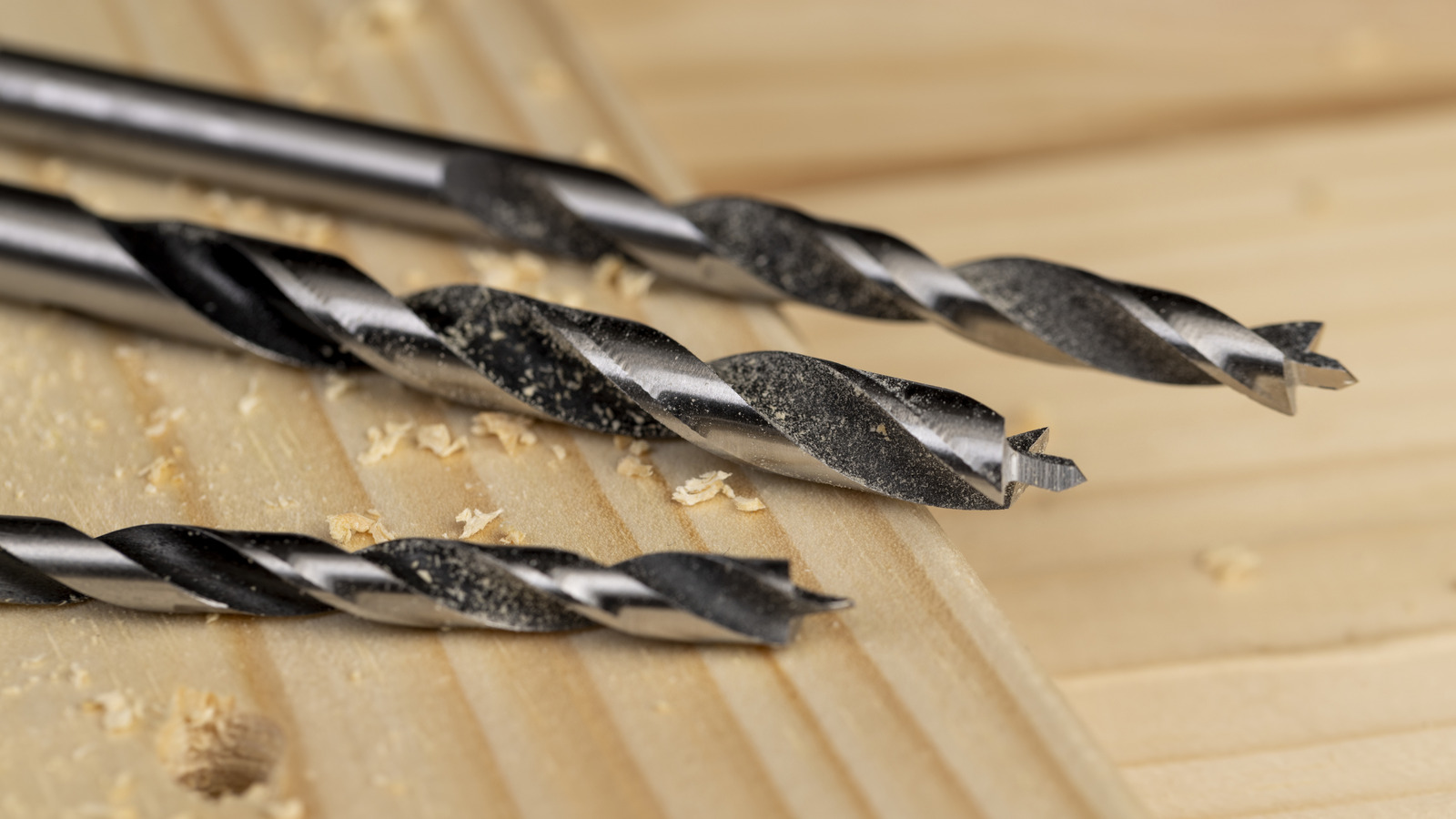
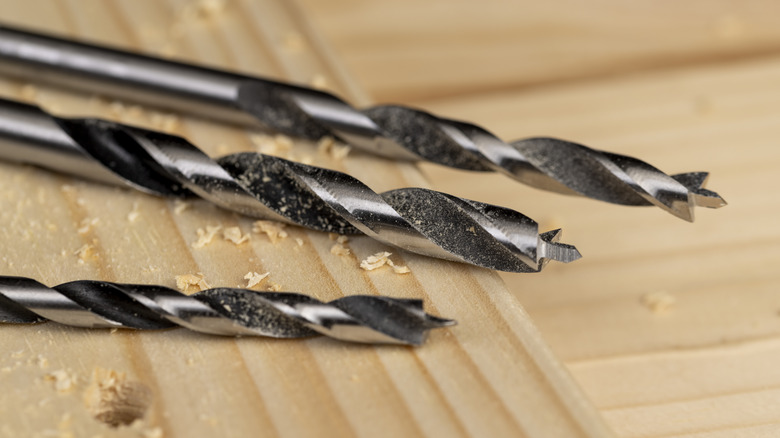
Semi-blunt bits are ideal for shearing through metal, but they can actually be a hinderance with a wooden workpiece. Renovators may want to reach for a brad point bit, which features a small point that sticks out from the peak of the bit's cutting '"teeth,"instead. This allows you to line up your cut on a board, biting into the wood fibers ahead of the main bit, and keeping the unit centered as it lowers into the piece.
I am a frequent user of drill bits. I've used a plethora of them through numerous home improvement projects and other building tasks through many years of tool use. I've also broken countless multi-material bits in my younger, less experienced years while using them instead of a brad point alternative! These two bits are just the tip of the iceberg, both in my own renovations and for users across the spectrum of needs. These ten bits go well beyond the typical accessories you'll encounter, allowing for major expansion in the types of tasks you can easily tackle for a variety of successful DIY projects.
Earth auger bit
 Aleksandarnakic/Getty Images
Auger solutions can be found in a few different overarching formats including dedicated auger tools that don't operate as drill accessory solutions. However, these tools can be expensive. For many homeowners, having a full sized auger unit just won't make a lot of sense; "overbuying" in this way is one common home improvement mistake that DIYers make. Buying a drill bit that does the same work instead can be exceedingly valuable, because it expands your capabilities while keeping your tool expenses low and eliminating the need to find a place to keep a large addition to your collection.
An earth auger drill bit can serve in a few important roles. They be a useful step when preparing a garden bed or other areas of your landscaping for new plants. Churning the soil is great for breaking up weed roots, interrupting their growth process and keeping your soil in a healthy state. This is also a natural solution to break up dense soil that has become waterlogged ahead of planting bulbs or seeds.
Another key function at the earth auger bit provides can be found in concrete work and fencing tasks. Breaking ground on hard, compacted soil is difficult at the best of times. If you're sinking new fence posts or looking to dig into the soil to lay a concrete foundation for something new, an auger bit can help get the process started with less fuss and effort.
Universal socket bit
 Effecteer
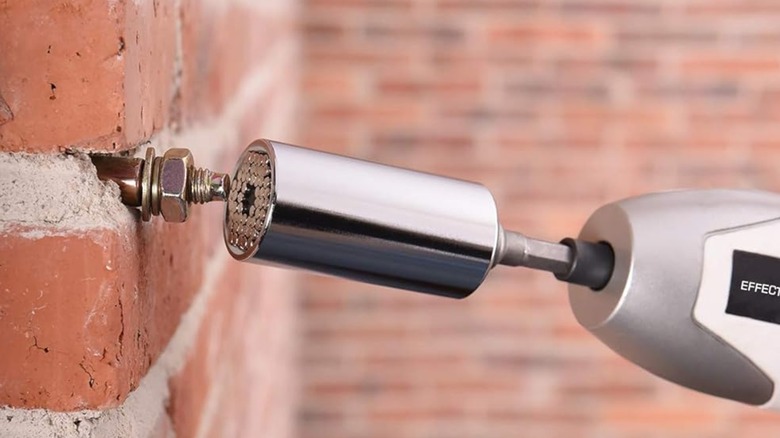
Many tool users may have seen the universal socket bit bouncing around Amazon lately. It's something sold by a range of Amazon's odd letter name brands, and it doesn't do one particular job, but rather acts as a wide-reaching socket solution for non-standard requirements. It could be a good option for impact wrench users who find themselves swapping socket bits frequently during a single job. This accessory bit can speed up the process substantially in this regard, making your work a little less cumbersome.
These universal bits feature an outer ring and an overarching build structure that looks a little like a standard socket. However, within the outer rim you'll find a collection of smaller circular or hex shaped bars that retract when you push the tool into a fastener head. The universal bit gets lowered on to a fastener as you would with any other wrenching tool, and bars retract based on the size requirements of the job. What's left over is an internal diameter that's the perfect size to grip on to the fastener and start the turning process. These universal bits can also be leveraged for angled grips on fasteners when necessary. Because of this retractable nature within the bit's central reservoir, there is a natural ability to create Just enough connection strength to turn fasteners even when the bit isn't flush with the head it's engaging.
Flexible bit extender
 Ilham Firdaus Yusuf/Shutterstock
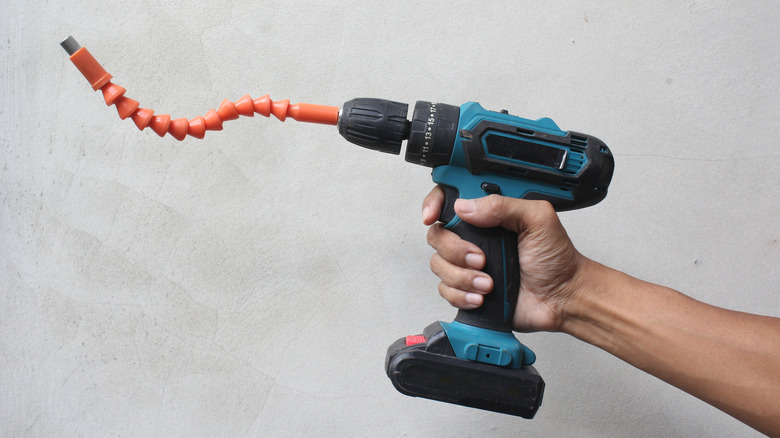
One of the most useful attachments you'll find for your drill is a flexible bit extender. Available from a range of makers, including mainstream brands like Ryobi and plenty of others from Amazon and beyond, this sort of bit fits between your drill and the bit you actually want to use. Rather than providing a typical extension experience, flexible extensions allow you to turn and curve around obstacles to your work. A flexible extender allows you to drill from one angle while engaging the workpiece at a completely different one.
It's important to note that you won't achieve much physical pressure against a screw you're trying to drive with this kind of extension tool, but it can be a serious upgrade over more delicate hand tools when building things like drawers from flat pack furniture boxes. You'll sometimes find that fasteners in these components need to be placed right up against tight corners and edges. Similarly, in smaller drawers you may have a hard time getting your drill to fit within the box itself when driving a fastener. An installation driver like Milwaukee's M12 Fuel option can work here, but a flexible bit extender is a much cheaper alternative.
Self-centering bits
 Lee Valley Tools
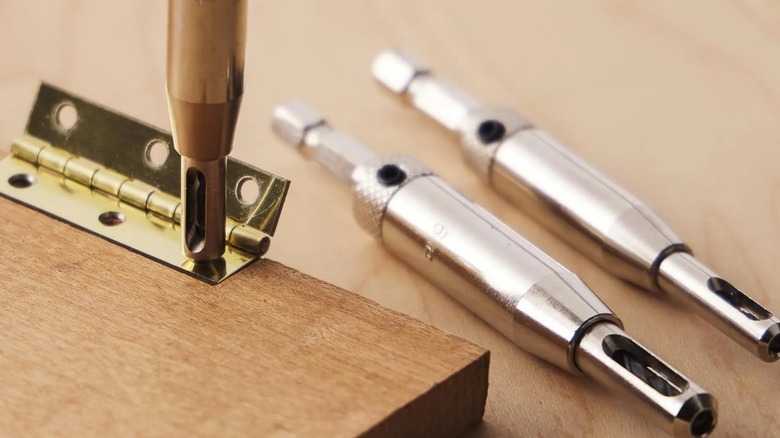
Self-centering bits act as an ideal choice for installing door hardware, in particular. They allow you to drill pilot holes ahead of hardware installation, but remove the guesswork and frustration of missing your mark with genuinely impressive ease. A self-centering bit features a small bit contained within a sleeve. When you start to press into your workpiece the bit extends downward, and in coordination with the outer sleeve, ends up getting forced into the center of your target area as it meets the target surface.
The spring-loaded action that underpins this accessory tool allows you to confidently place your pilot hole right where you want it while virtually eliminating concerns over wandering action from the bit. This essentially defeats the worry over a marred surface or issues with incorrect angles of attack. Self-centering bits play a big role in door installation, but they are a crucial solution for placing hinges on cabinets (which is essentially the same task in a smaller format) as well as cabinet handles, drawer slides, and other precision work.
Forstner bit
 breakermaximus/Shutterstock
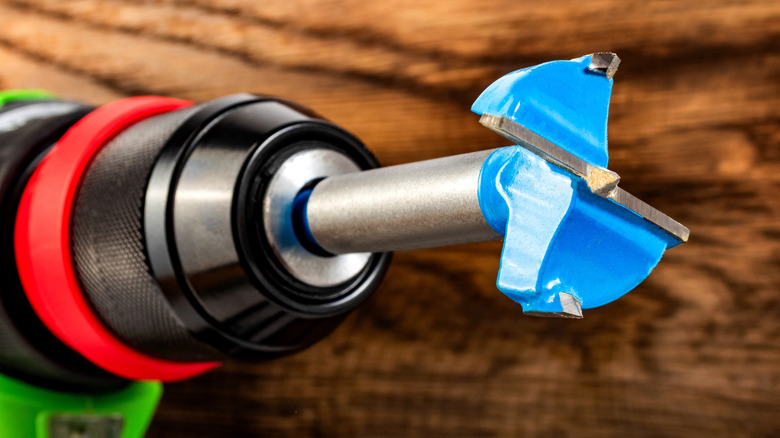
The forstner bit features a smooth circular diameter around internal cutting mechanisms. The bit is often paired up with a drill press in order to produce perfectly square cuts in a workpiece, but they can be used with standard drills, as well. The forstner bit is used to bore through boards and has the unique capability of producing clean entrance and exit holes as you enact a cut. It's also possible to use this bit to cut a recess in a board, and in doing this you will create a cleaner finished product, on the whole.
These bits can clear away left over waste material in shoulders and other elements cut for joinery, and because of the flat surface left behind, they're helpful for cutting partially through boards, too. Forstner bits are also ideal for cutting small recesses for inlaying contrasting color plugs, magnets to support door or drawer mechanisms, and more. This is something of a specialized tool, so it may not be particularly useful for those outside of the woodworking world, but the reality of the bit's value within this realm remains strong.
Countersink bit
 AW777_Photo/Shutterstock
Countersinking is something many people working on rudimentary projects forget to include in their workflow. Without a countersink bit, it can be difficult or even impossible to achieve this end result in your work, and so many people simply overlook it. However, a countersink bit in your collection can drastically improve the quality of your projects. This is especially true for small, fine woodworking projects like vanity boxes or spice racks. Countersinking screws is also extremely valuable larger builds, like a tree house for your children or cabinetry for a built in unit around your television. A countersink bit cuts a wider arc into the face of the workpiece, creating space for the screw head to fit neatly beneath the surface of a board. Rather than leaving a screw head proud or ramming it forcefully into the workpiece and potentially splintering the board, the countersink bit allows you to neatly and easily hide fasteners beneath plugs or wood filler during the finishing touches of your build.
Because countersinking screws provides a more delicate touch, this allows you to avoid breakage along the surface of just about any project. When installing decking boards or railings for a backyard fort, for instance, this means a reduced likelihood of catching splinters in your fingers or toes while enjoying the structure. In finer outputs, countersinking allows for a more complete visual finish that looks professional and elegant.
Wood plug hole cutter
 Axminster Tools
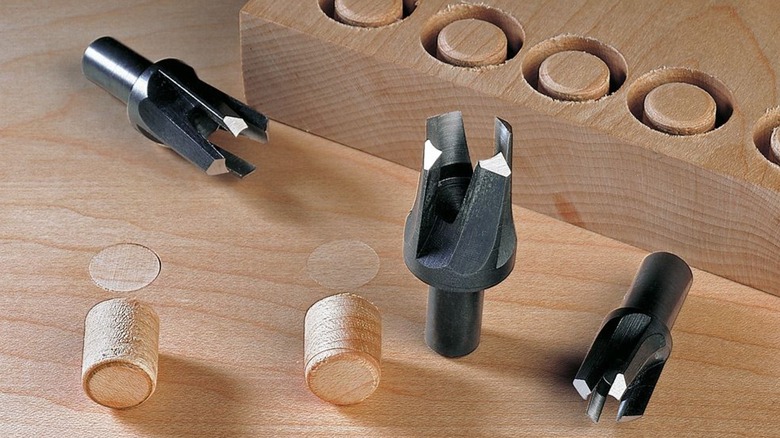
Cutting plugs isn't a task DIY enthusiasts working with rough timber and basic build parameters will typically encounter. However, it's a useful skill to have in your repertoire. Cutting plugs yourself allows for expanded customization when putting finished details on many projects, including those that aren't designed necessarily to turn heads and grab attention. Using plugs cut from other wood stock can be a solution to covering screw heads and making a structure safer for your children or just a little nicer looking overall.
One reason for a lack of knowledge about this kind of cutting tool may be due to the fact that this detail can easily feel like something only experienced carpenters or woodworkers prioritize. But the reality is that cutting plugs to boost your finished product is just a matter of having the right drill bit. A plug hole cutter bit fits right into your drill and allows you to cut out stock with clean, precise cuts. Having one of these bits in your toolbox expands what is possible in the work you tackle around the house.
Hole saw
 Ales-a/Getty Images
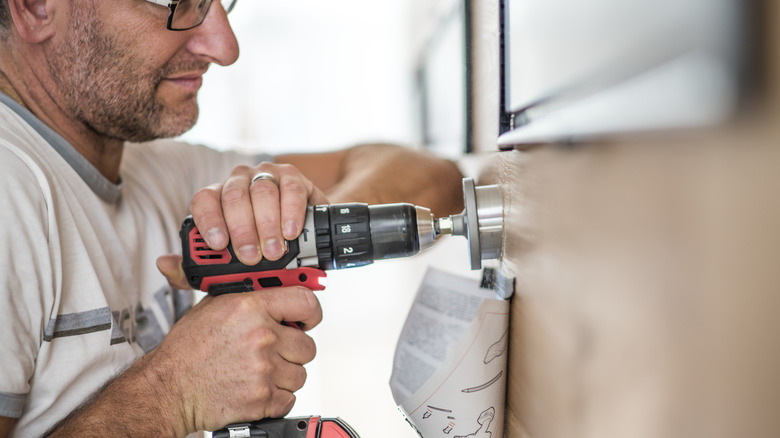
The hole saw works a little like a spade bit, in that it hogs out circular holes in wood. It's great for making perfect circular cuts, and they come in a wide range of sizes. It's also possible to find a hole saw options that can tackle alternative materials beyond just wood. The spade bit doesn't offer this kind of versatility. The two circular cutting tools also go about their task in different ways. While the spade bit hogs out material entirely, a hole saw features a pilot on a mandrel and the circular cutting disk attached behind it. The result is a single puncture in the center of your intended cut and a tool that cuts out the entire circle and removes all of the interior material. You'll come away with something resembling a donut with a hole saw.
The hole also features heat relief points and other elements built into its body to help keep the tool cutting for longer. As a result, you won't need to stop midway through many cuts to remove built up waste or let the cutting bit cool down. This makes the hole saw an ideal tool for cutting holes in studs and other construction to run pipes or wires behind the stud wall or elsewhere because of their perfect circular cutting capabilities, hole saws can also be utilized in a range of precision work in building woodworking projects and other elements beyond the construction arena.
Masonry bits (and SDS bits)
 ismailGazel/Shutterstock
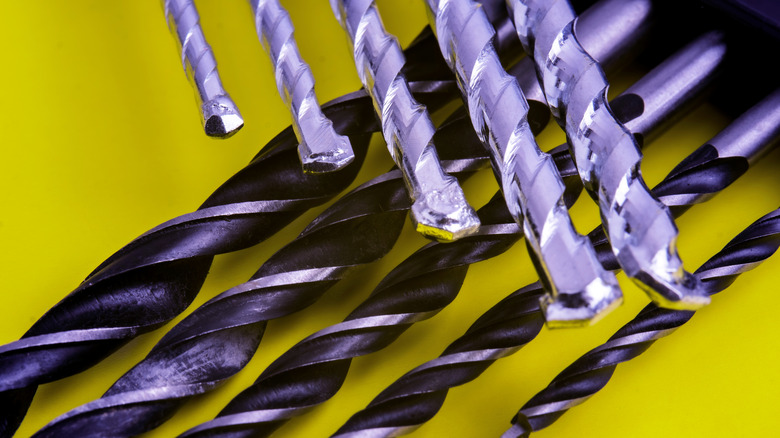
A masonry bit looks a little like a standard multi-material or high speed steel cutting implement. However, these bits feature a pair of "wings" at their tips and special hardening to support far denser drilling needs. Masonry bits are designed to handle block, concrete, and brickwork, smashing through hard material where any other bit would falter and break. They're essential for anyone working on projects in a home built from block, or those tackling driveway or garage floor repair. Masonry bits often come in bundle packages with other drill bits, so many users may already have at least a basic set of these cutting implements in their toolbox without even knowing it.
SDS bits are another type of masonry drilling tool, featuring grooves along the back end where the bit seats in your drill. These grooves allow the bit to lock in more completely, providing better stability when used in concert with an SDS drill's intense hammer action. I can say from experience that while they don't fit exceedingly well in a standard drill, you can use them this way in a pinch. You'll likely end up with a bit of wobble unless you can really lock down the chuck, so it will need to legitimately make sense to "misuse" the tool like this. For instance, I did this recently because I didn't have the right size in a standard masonry bit and also didn't want my SDS drill to blow debris all over a room that wasn't covered up properly.
Step bit
 Rubanitor/Shutterstock
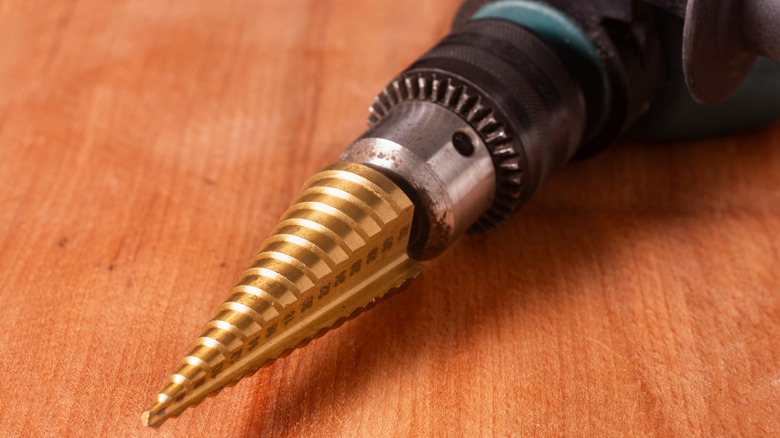
A step bit features a rounded pyramid shape, with different levels layered from the base to the tip. Each one features a ledge, or "step," that flares out by a preset amount, giving you a progressively larger, rounded cutting tool. If you're looking to expand a hole but you're worried about accidentally cutting it too wide, a step bit can be a key asset.
Step bits also make it possible to cut holes of varying sizes in a workpiece without having to swap bits. A user working through a large cut list can really speed along their process by using a step bit instead of a collection of individually sized cutting implements. Step bits are particularly useful when working with thin, sheet metal products. Cutting holes in a workpiece to create a tie point or ahead of tooling the cut to create screw threads can be easily achieved with a step bit.